-
Magic: the Gathering
Pokemon
Flesh and Blood
One Piece
Digimon
Star Wars Unlimited
Lorcana
Union Arena
Final Fantasy TCG
Grand Archive
CookieRun Braverse
Gundam CCG
Elestrals
-
-
-
-
-
-
-
-
-
-
-
topConan (Used)
Conan (Used)
Regular Price $39.99Product Type : Board Games
Hurry! Only0unit(s) left in stock!
Customer Support407-951-5822Conan, designed by Fred Henry and based on the Conan universe by Robert E. Howard, is a scenario-based semi-cooperative asymmetric miniatures board game. One player is the Overlord, playing the opposition forces, and the other players (1 to 4) play Conan and his companions: Shevatas the thief, Hadrathus the Priest/Sorcerer, Belit the pirate queen, Valeria the warrior, etc. The game is based purely on Robert E. Howard's novels and short stories (and not the movies or other non-Howardian material). The publisher has hired Patrice Louinet, a Howard expert, to make sure the art and the scenarios are compatible with Howard's vision.
Each game is a scenario, played on a map. There are 4 maps included in the retail copy of the game, and each map can have several scenarios set on it. The game is fast, one hour approximately. It's possible to play several scenarios in a campaign, but you can also play each scenario individually. There are 9 scenarios in the base box.
At the beginning of a scenario, players choose their team (Conan and two or three other heroes). The Overlord gathers all the miniatures (picts, Necromancer, skeleton warriors, monsters, etc.), tokens, and cards from the chosen scenario. The game usually plays in a limited number of turns (ten, for instance). Each scenario can have very different objectives: find the princess captured by picts and hidden in a hut and leave the camp before the pict hunters return; find the magical key to open a sealed door, steal the jewel and leave; kill the Necromancer by the end of turn 10; survive by the end of turn 10; escape the prison; etc.
During their turn, the heroes can activate or rest. If they activate, they can spend "gems" from their energy pool to do all sorts of actions: move, fight (melee or distance), defend, pick a lock, reroll, etc. If they rest, they can move a lot of gems from their "spent" pool box to their "available" pool box. When they take an action, they throw a number of dice equal to the number of gems they put in their action. There are three different kinds of dice: yellow (the weaker dice), orange (medium) and red (strong). Each character has a color based on their specialty: Conan throws red dice in combat while the Sorcerer throws yellow dice in combat; the thief throws red dice in Manipulation actions, while Conan throws orange dice; etc. Each player can have equipment cards (armor, magic potions, weapons, etc.) which give them bonuses on their dice rolls.
The Overlord plays differently. He uses a board with eight slidable tiles, plus his own Energy gems. Each tile corresponds to one unit (1 to 3 miniatures) on the game mat, and all of the miniature abilities are written on this tile (movement, armor, attack, special abilities). The tile position on the board corresponds to the numbers 1-8. The Overlord has a pool of energy gems and each time he activates one unit, he needs to spend a number of gems matching the tile placement: tile#1 costs 1 energy gem, tile#2 costs 2 gems, etc. Whatever tile the Overlord chooses to activate, he spends the corresponding energy cost (moving his energy gems from the available pool to the spent pool), then takes the tile out and moves it to the end of the sliding track: If he wants to activate this unit again, it will cost him 8 gems, because the unit is now on position 8. The Overlord can activate a maximum of two tiles, and he regains only a certain number of gems each turn (depending on the scenario).
In a typical scenario, the heroes need to accomplish something and the Overlord wins if the heroes fail to reach their objective — but in some scenarios, the Overlord has his own objectives and the Heroes win if they prevent him from accomplishing his goal.
We have a 15 day refund policy on sealed or unused new products. The return must be accompanied by a receipt from our store. If a receipt cannot be provided store credit will be provided at the lowest sale price within the past 6 months.
Trading card game items such as booster packs or sealed boxes are not returnable unless they have not left our physical building.
Any and all tcg boxes are not guaranteed to be in perfect condition. All items we carry will have intact (but perhaps not perfect) shrink wrap, if originally produced with shrink wrap. If you are purchasing an item for a sealed collection or expect perfection, please do not shop with us. We will not accept your return and we don't want to deal with sending dozens of pictures so that you can inspect our products via email.
If an item is shipped and arrives damaged, an insurance claim will be filed and reimbursement will be passed on once the claim has been fulfilled
Any products that are bought used can only be returned if they are found to be defective or not as described when purchased. These items may be returned, but only before leaving the store. It is recommended that buyers inspect any used games thoroughly before purchasing to find anything that was potentially missed during the store's initial inspection upon acquiring the game.Added To Cart :Add To Cart Failed :product successfully added to wishlist!The Grading Guide
''Near Mint (NM)'
Near Mint condition cards show minimal or no wear from play or handling and will have an unmarked surface, crisp corners, and otherwise pristine edges outside of minimal handling. Near Mint condition cards appear 'fresh out of the pack,' with edges and surfaces virtually free from all flaws. '
'
''Lightly Played (LP)'
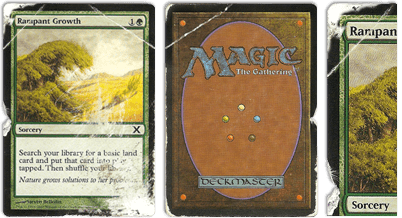
Lightly Played condition cards can have slight border or corner wear, or possibly minor scratches. No major defects are present, and there are less than 4 total flaws on the card. Lightly Played condition foils may have slight fading or indications of wear on the card face. '
'
''Moderately Played (MP)'
Moderately Played condition cards have moderate wear, or flaws apparent to the naked eye. Moderately Played condition cards can show moderate border wear, mild corner wear, water damage, scratches , creases or fading, light dirt buildup, or any combination of these defects. '
'
''Heavily Played (HP)'
Heavily Played condition cards exhibit signs of heavy wear. Heavily Played condition cards may include cards that have significant creasing, folding, severe water damage, heavy whitening, heavy border wear, and /or tearing. '
''
''Damaged (D)'
Damaged condition cards show obvious tears, bends, or creases that could make the card illegal for tournament play, even when sleeved. Damaged condition cards have massive border wear, possible writing or major inking (ex. white-bordered cards with black-markered front borders), massive corner wear, prevalent scratching, folds, creases or tears. '
'